Liberal Seagull reads...
Who I read:
Who I listen to:

The damned of Hell suffer eternal punishment because they experiment with the loss of God.
In my own soul, I feel the terrible pain of this loss. I feel that God does not want me, that God is not God and that he does not really exist.
There are some things the government can do more efficiently than the private sector.

Gonzales is out of here.ALBERTO GONZALES: I prepare for every hearing, Senator.
SEN. ARLEN SPECTER: Do you prepare for all your press conferences? Were you prepared for the press conference where you said there weren't any discussions involving you?
ALBERTO GONZALES: Senator, I’ve already said that I misspoke. It was my mistake.
SEN. ARLEN SPECTER: I’m asking you: were you prepared? You interjected that you’re always prepared. Were you prepared for that press conference?
ALBERTO GONZALES: Sir, I didn’t say that I was always prepared. I said I prepared for every hearing.
SEN. ARLEN SPECTER: Well, then, I’m asking you: do you prepare for your press conferences?
ALBERTO GONZALES: Senator, we do take time to try to prepare for the press conference.
SEN. ARLEN SPECTER: And were you prepared when you said you weren't involved in any deliberations?
ALBERTO GONZALES: Senator, I’ve already conceded that I misspoke at that press conference. There was nothing intentional. And the truth of the matter is, Senator, I --
SEN. ARLEN SPECTER: Let's move on. I don't think you're going to win a debate about your preparation, frankly.

In Britain they have a thriving alternative party known as the Liberal Democrats. The Libdems didn't start out by aiming for power in Parliament, they went for power in the local councils and townships. As they became well known and well respected, it made it possible for them to move up into federal power as well.
The third parties in the US tend to go straight for Federal power, rather than doing any long term planning. Let's say we revived Teddy Roosevelt's Progressive Party. Let's say the Progs managed to eventually start capturing some power at the county and state levels. Let's also say that this party was then able to prove itself as a positive and effective force that generated great voter loyalty. Eventually, the possibility would be there for them to move up into Federal politics. If nothing else, their popularity might cause the Federal parties to become more left leaning.

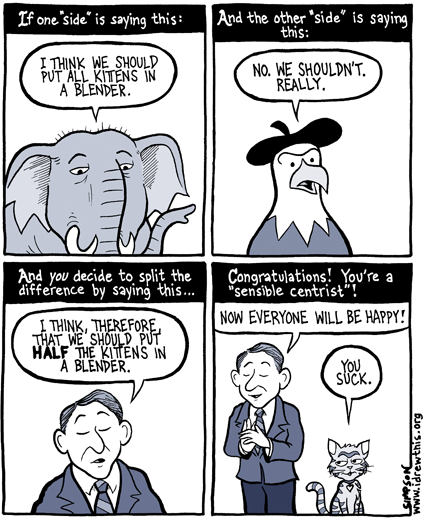
The nature of the U.S. electoral system is to create two-party rule. In the case of Presidential elections, this is simply a function of how voting works -- two candidates with similar ideologies will split the vote, causing the remaining candidate to get a plurality and take the election. This same principle operates in Congressional elections, as well -- with the added feature that the rare independent or third-party candidate who does manage to get elected will have to caucus with one of the two major parties in order to accomplish anything. This is because of the committees, where much of the work of legislating actually gets done, and which the two major parties divide up based on who currently has a majority.
Voting for a third party as a protest vote is easy, and feels good. Since your candidate has no chance of winning, no matter what happens you get to disclaim any responsibility by saying, "don't blame me -- I voted for the other guy!" In the end, however, it really only helps the candidate that least reflects your views.
So if voting for third parties is ineffective, what can you do? Work within one of the existing parties. Write letters. Make phone calls. Donate money to primary candidates you like. This is a lot more work than voting for a third party, but it can accomplish so much more.
The actions of conservatives can be instructive, here. When they didn't like the Immigration Reform Bill, they didn't go off in a huff and vow to vote for the Constitution Party. They wrote letters and made phone calls to Republican politicians, and they got results -- within a week or two that bill wasn't just dead, it was radioactive.
To accomplish anything in the House, a party needs a majority. To accomplish anything in the Senate, a party needs 60 votes. (If they have a truly hostile President to overcome, they might need a two-thirds supermajority in both houses.) If these thresholds aren't reached, it doesn't matter much how ideologically pure and united they are; nothing will get accomplished without significant compromises. For that reason, sometimes it's necessary to hold your nose and vote for someone you don't like in the general election, just because it'll nudge the party you prefer closer to those magic numbers. No one likes doing this, but sometimes it's the lesser of two evils. And...
Unless you're voting for yourself, there isn't a politician out there you won't disagree with on some issues. Representative democracy is about picking the person who will best represent your interests out of the choices available; it accomplishes nothing to hold out for perfection.
Beagle already said all there is to say about Karl Rove leaving, which of course is today's big news (so far)."Because if we lose and fall under religious law, there not only will be no gay marriage, there will be no women's rights, no freedom of the press, no basic human rights, not even – as in the case of Iran – any music."
In theory, everyone agrees with this. The problem is, I haven't yet come across a single person who's proposed a workable solution. Who gets to decide whether an issue is still debatable? The reporter? But most reporters aren't subject matter experts. Would you trust the average reporter to take on this role on a daily basis? And even if we do believe reporters should be routine arbiters of the truth, how exactly should they express this? Flatly call things lies? Insert contrary evidence in their own voice whenever they decide someone has crossed the line? Something more subtle?
Karl Rove is to quit at the end of August.
The conservative cult's mass death wish is obviously based on a faulty premise, that if there's a terrorist attack they and Dear Leader will somehow be vindicated. Of course the reverse is true. When it comes to "the war on terra," George Bush and the conservative movement have pretty much gotten everything they've wanted. Democrats and dirty fucking hippie bloggers, despite complaints, haven't managed to stop the Bush administration from doing what they think is important.
So if a massive terrorist attack happened, it wouldn't be a vindication of what they've been doing, it would be proof that they failed to do what George Bush claims is his most important job.
A lot of us are angry about the Democrats being steamrollered on the terrorism surveillance bill. But we need to make sure we're targeting our anger at the right people. With that in mind, here's a list by state of how Senators voted on the bill. Find out how your Senators voted, and either thank them or give 'em hell.
An interesting bit of perspective on the Minneapolis bridge collapse, submitted to Risks Digest by Sidney Markowitz:...it would have cost a little over 10 minutes of Iraq war expenditures to have repaired the I-35W bridge before it collapsed, and now it will cost about 100 bridges worth of preventative maintenance to repair this one bridge after the fact.
Y'all know me. And you know I'm a card-carrying Democrat, and believe our best hope for getting some good done in this country is to support the Democratic Party.
We do not need to wonder or speculate about what might happen if Democrats obstruct warrantless eavesdropping legislation and Republicans are then able to make an issue of it politically. That already happened in 2006. That was Rove's whole strategy. It failed miserably, across the board. And yet the Democratic leadership just permitted, and many Democrats supported, a wild expansion of George Bush's warrantless eavesdropping powers based on a jittery fear of this already-failed tactic, if not based on actual support for these increased eavesdropping powers.
This is a story that should be getting more coverage.
Thomas Frank, in his 2004 book "What's the Matter With Kansas?" famously asked why so many people in middle America vote against their own self interests.
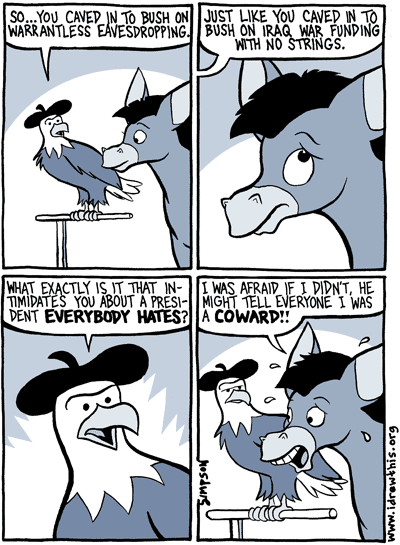
Under pressure from President Bush, Democratic leaders in Congress are scrambling to pass legislation this week to expand the government’s electronic wiretapping powers.
Democratic leaders have expressed a new willingness to work with the White House to amend the Foreign Intelligence Surveillance Act to make it easier for the National Security Agency to eavesdrop on some purely foreign telephone calls and e-mail. Such a step now requires court approval.
[...]
In the past few days, Mr. Bush and Mike McConnell, director of national intelligence, have publicly called on Congress to make the change before its August recess, which could begin this weekend. Democrats appear to be worried that if they block such legislation, the White House will depict them as being weak on terrorism.
Back in May, Liberal Beagle posted about a Supreme Court decision in which the Court ruled that a woman could not sue for two decades' worth of pay discrimination because the 180-day statute of limitations had expired.